
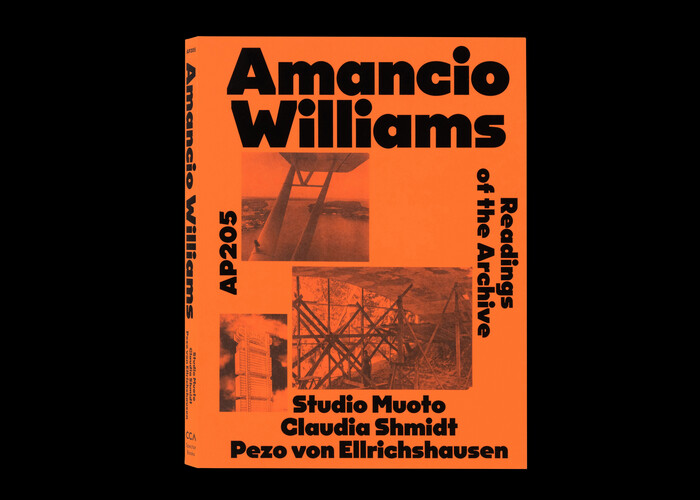
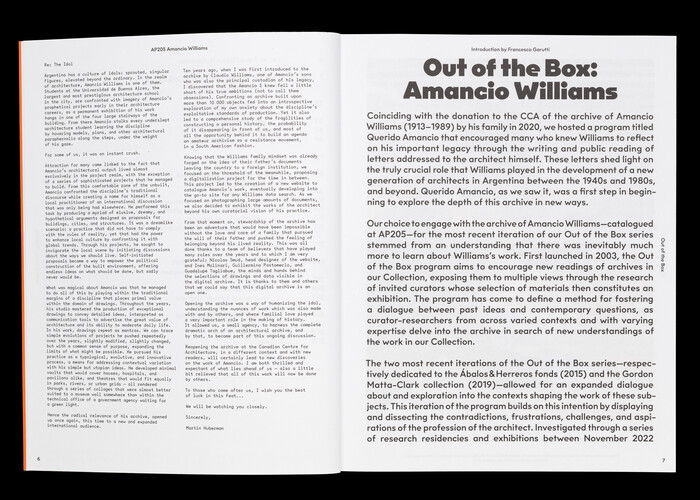
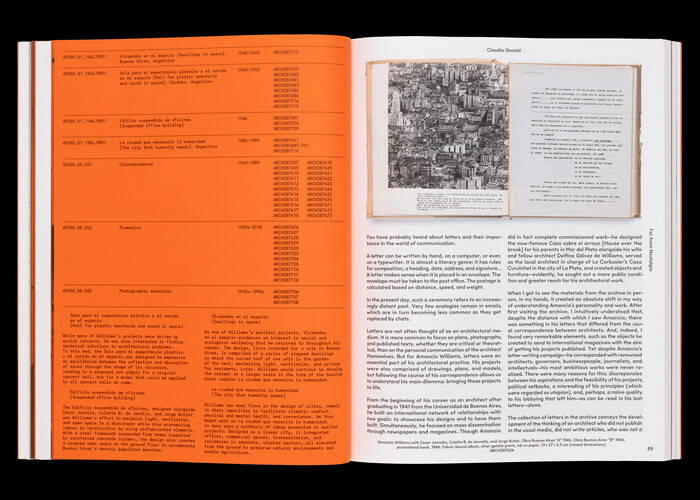
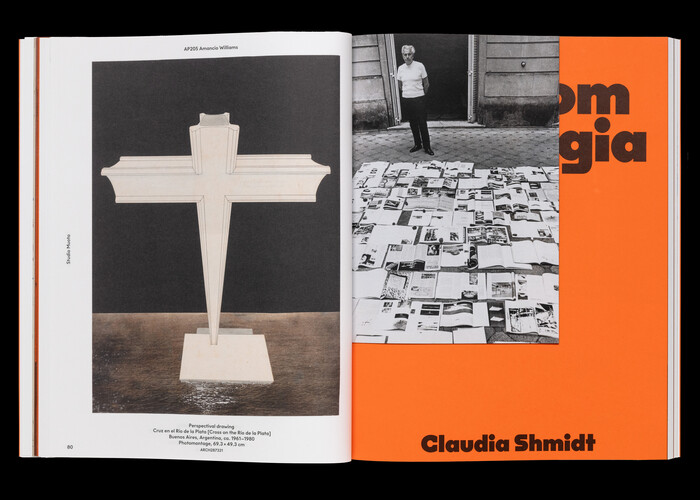
Design studioOur Polite SocietyusedOPS And Ever, a newly released sanserif byOPS Type, for thisbook of archival researchinto Argentinian architectAmancio Williams(1913–1989) published by theCanadian Centre for Architecturein partnership withSpector Books. Readings by Studio Muoto, Claudia Shmidt, and Pezo von Ellrichshausen present new and expanded understandings of Williams’s work, and situate the social, material, and political dimensions of his practice within contemporary architectural discourse. OPS And Ever, designed byJan Egbers, is a proportional update and continuation ofOPS Favorite, a monospace released by the foundry in 2019. In the book, it is used alongside the mono, which still features in the indexes. The headings and cover of the book are set in a still-unreleasedUltracut of the typeface.



This typography system communicates intellectual rigor with contemporary accessibility—the kind of scholarly authority that doesn't intimidate. OPS And Ever's rational form model, with its closed apertures and vertical stress, establishes editorial credibility, while its proportional refinement of the monospace DNA softens the technocratic edge into something more humanistic and approachable for architectural discourse.
OPS And Ever works brilliantly for this architectural monograph because its rational structure mirrors the precision of architectural thinking while its proportional adaptation from monospace origins echoes the transition from technical drawing to published discourse. The closed apertures and vertical stress provide the editorial authority needed for serious scholarship, while the Ultra weight creates powerful hierarchical contrast without abandoning the systematic character that connects to Williams's own systematic architectural approach.
This pairing exemplifies perfect structural harmony through Kupferschmid's same-form-model rule—both proportional and mono versions share identical rational DNA with closed apertures and vertical stress, differing only in character width. The mono's retention for indexes maintains functional clarity while the proportional version handles flowing text, creating contrast through width variation rather than fundamental structural change. The Ultra weight extends this systematic thinking into bold hierarchical territory.