
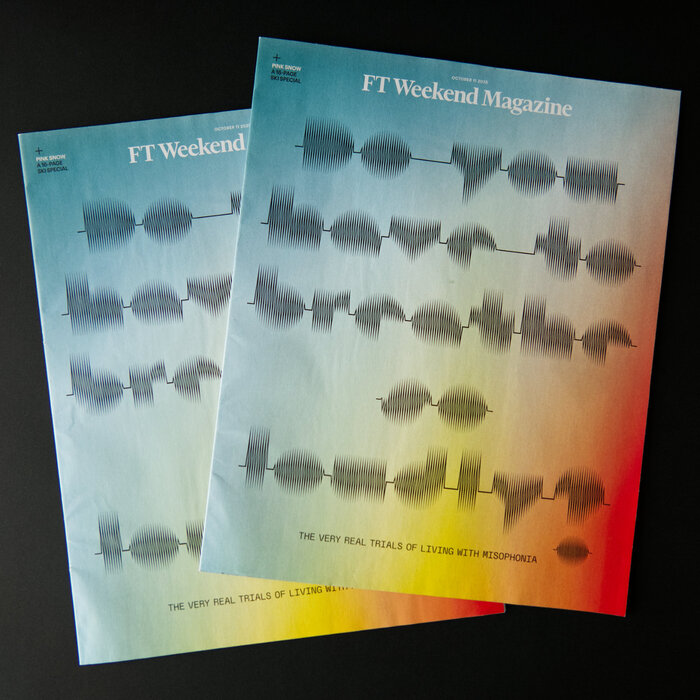
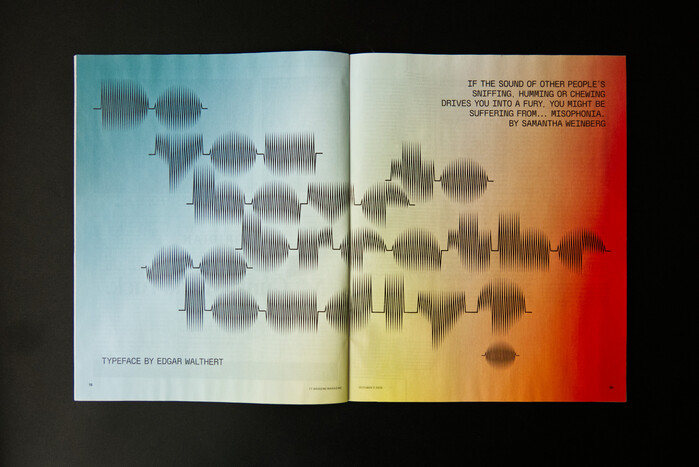
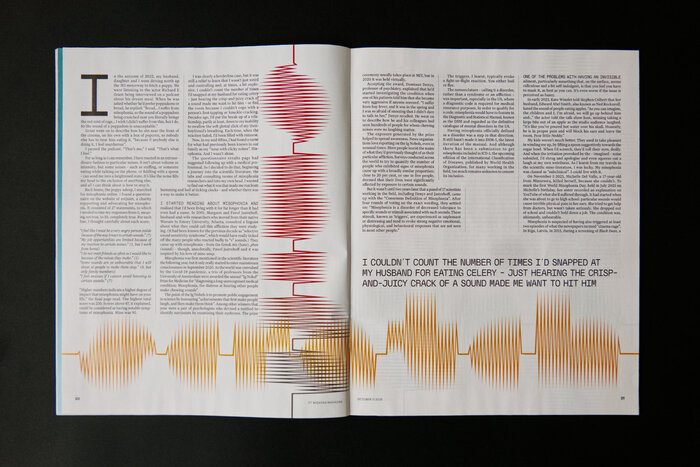
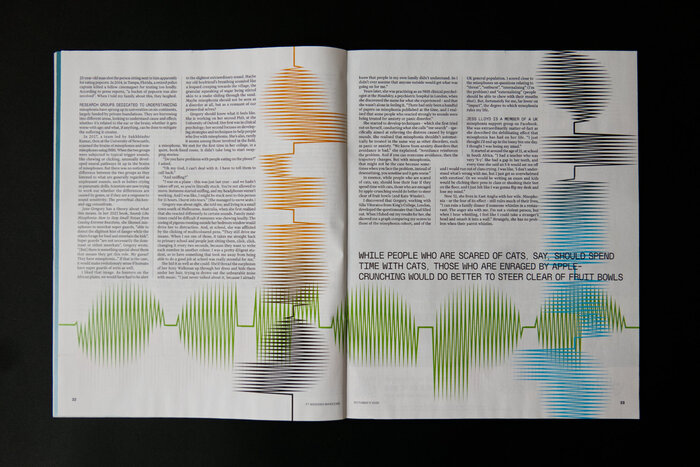
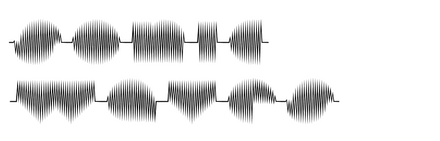
In September 2025, Brian Saffer, Art Director atFT Weekend Magazine, reached out to me about the possibilities of using my typefaceSonic Waves. He was working on the cover design for an issue about amisophonia, a hatred of particular noises. Brian Saffer created an uppercaseDand added a dot below the question mark, to increase readability. At the release date of October 11th, an e-mail by aFTreader reached me, pointing out how a typeface I made for the love of music is now used for the opposite purpose. That is not unusual in type design, since we develop tools that are not finished products but will be applied for various purposes by their users. Sonic Waves was created in 2008 for the online and offline exhibitionInto Infinityorganised bydublab. As an occasional DJ and designer for the web radio station, I took it on to combine these two practices into one.Inspired by thespectrographic imagesthat Aphex Twin embedded in some of his tracks and waveform art shared in early 2000s IDM forums, Iwas researching the possibilities of drawing or shaping sound waves into letters.AMacOS 9audio software that I was still able to run on my PowerBook enabled me to achieve this. In the mode that made it possible to manipulate the waves, the proportions were horizontal stretched. The process to create the shapes Ineeded was to work with elliptic outlines on transparent paper that I laid on top of the screen as templates to fill in. The typeface was accompanied by sound files in scales C, C#, B, D and H. The font comprised lowercase letters only, since many uppercase letters would have been difficult, impossible or proportionally awkward to make. The middle line lays at the centre of the x-height. This creates many restrictions which already forced met to set the numbers in italic. Without that trick,0and8would be indistinguishable. The other typefaces used alongside Sonic Waves are all-capsAvenue Monoand theFT’s standardFinancier Text. A Mac OS9 sound editor with the ability to draw sound waves manually To view this video please enable JavaScript, and consider upgrading to a web browser thatsupports HTML5 video Audio type specimen: here’s what Sonic Waves sounds like.


This typography system creates clinical empathy through conceptual precision—the visual manifestation of sound disturbance itself becomes the communicative tool. Sonic Waves' waveform-derived letterforms carry genuine scientific authenticity while maintaining editorial sophistication, transforming a medical condition into accessible visual narrative. The pairing creates intellectual intimacy rather than sensational drama, letting readers approach a sensitive topic through typographic metaphor.
Sonic Waves operates as pure conceptual typography—its waveform construction directly mirrors the auditory hypersensitivity that defines misophonia, creating meaning through structural metaphor rather than mere stylistic choice. The geometric form model, derived from actual sound wave manipulation, provides scientific credibility while the horizontal stress and unique baseline positioning create visual tension that mirrors the subject's psychological experience. Avenue Mono's rational monospace forms and Financier Text's editorial authority ground the experimental display face in journalistic credibility.
This is masterful conceptual pairing that transcends traditional structural compatibility. While Sonic Waves (geometric/constructed) and Avenue Mono (rational/systematic) represent different form models, they share a technical, almost clinical DNA that serves the medical subject matter. The monospace creates typographic restraint against Sonic Waves' visual intensity, while Financier Text provides editorial authority. The system works through conceptual coherence rather than optical harmony—each face serves the story's layered narrative of science, personal experience, and journalistic investigation.