
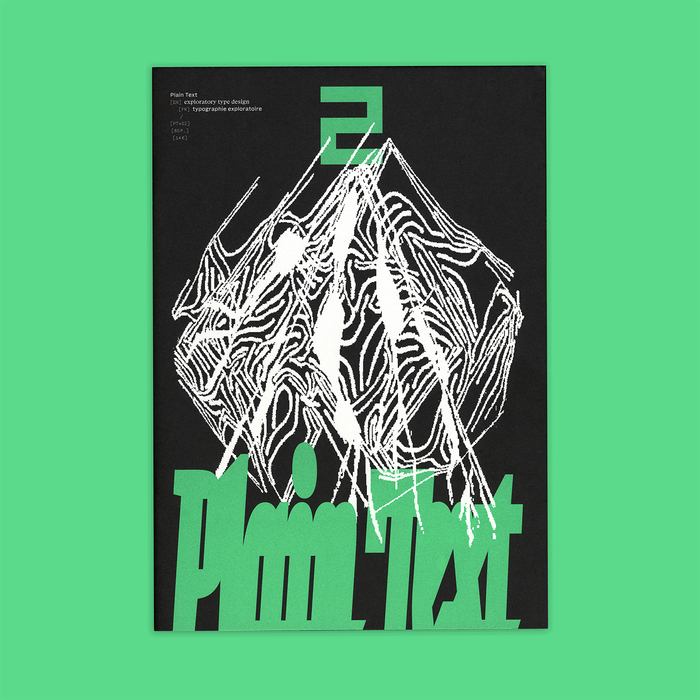
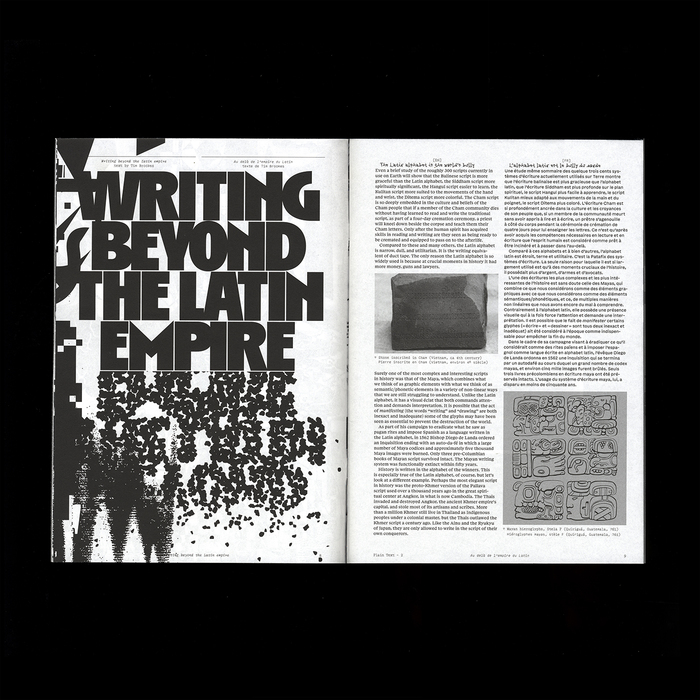
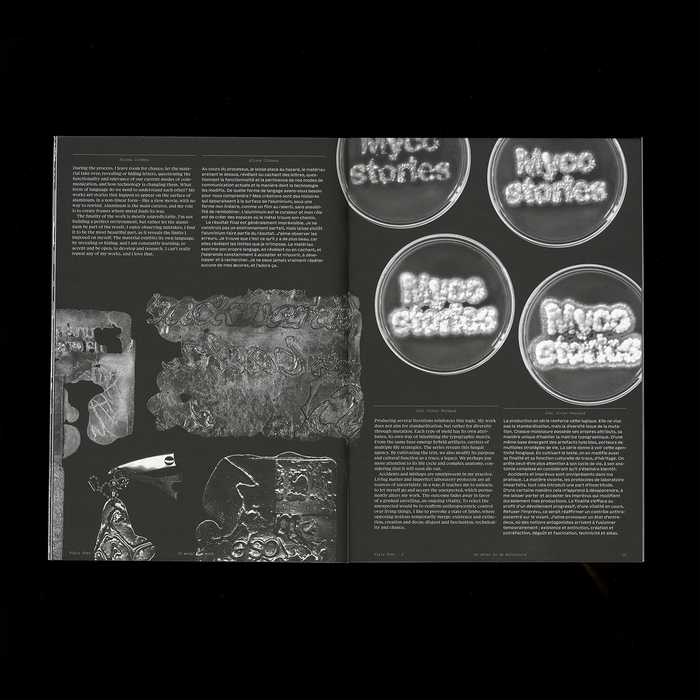
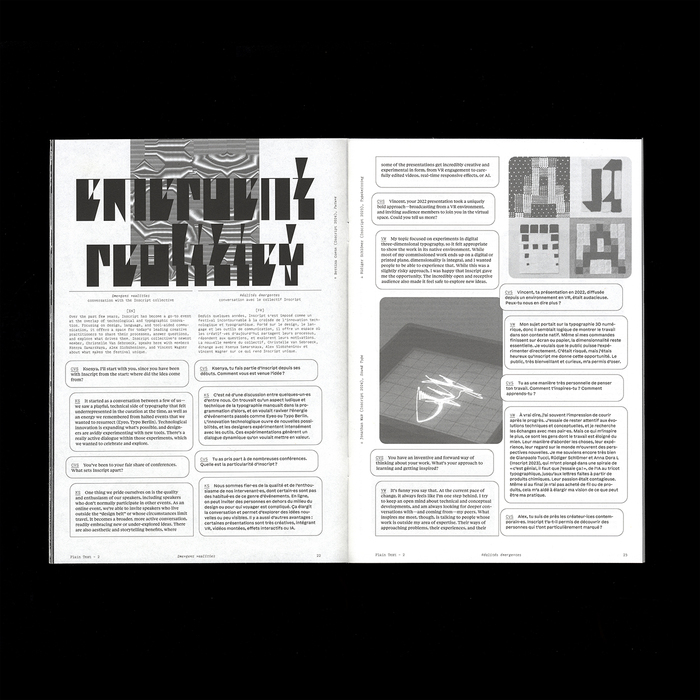
Plain Textis a printed publication for exploratory type design, edited and designed by Lucas Descroix and Benjamin Dumond, and published by type foundryPlain Form. The second issue launched in July 2025. From fiction to theory, from mystical analyses to visual works, Plain Text aims at exploring typographic imaginaries, moving beyond a strictly historical and technical framework, with a taste for the unknown and the dormant potential of writing. This second issue includes contributions by Hervé Aracil,Tim Brookes (Endangered Alphabets),Aliona Ciobanu,Lucas Descroix,Benjamin Dumond,Mardi Forestier,Inscript festival,Elenor Kopka,Marcus Leis Allion,Pierre Pané-Farré(withHAW Hamburg students),Simon RenaudandAlec Vivier-Reynaud. The texts of this black-and-white, bilingual publication are all set in the unreleased duoBasically Seriffor the English andBasically Sansfor the French. Additional information is set inBaskemo, alsoSerifandSans, an automatically monospaced-and-skelefont’edcompanion to Basically. A number of display typefaces designed by Lucas Descroix and/or Benjamin Dumond are used throughout, for the title of each contribution as well as various emphasis moments. These include:Michaux,Grandmaster,Disc,Jester(in several styles),Ready ActiveandCloudedand an early version of the upcomingFerro. Some unreleased display typefaces, either old or future, are also used but not shown here in the pictures. The fiction work by Mardi Forestier is set inExposureby Federico Parra Barrios. Imagined together with the author, the layout is an attempt at using an experimental typeface to underline and augment narration, its variations manifesting the idea of breath. • English and French• 80 pages, 210×297mm• offset print on Munken Print White• 1000 copies, July 2025• ISBN 978–2–9597254–1–8 This second issue ofPlain Textwas kindly supported byCommercial Type,CSTM Fonts,Dinamo,Future Fonts,XYZ Type, and205TF. Title is set in Disc Heavy, while subheads use Michaux Light. Left page shows works from Aliona Ciobanu (image in the center is a collaboration with designerStefaniia Bodnia). Right page shows the work of Alec Vivier-Reynaud (featuring mushroom-printedABC Camera). Title is set in a early version of Ferro Fraktur IV. Images show works fromBettina Comte,Rüdiger SchlömerandJonathan Mak. Title set in Jester Fool (squeezed, tracked and slightly blurred). Title set in Ready Active Regular (condensed and thinned). Title set in Grandmaster Thin. The right page shows both designs and inspirations from Simon Renaud. Left page shows designs and inspirations from Simon Renaud. Right page’s title is set in generously stretched Exposure. A piece of fiction by Mardi Forestier, making use of Federico Parra Barrios’s typeface Exposure to manifest breath. Title on the right page is set in heavily warped Jester Judgment (in black) and Jester Sun (in white). Left page features Ohno’s Swear. Right page features Bureau Brut’s Totentanz. Title set in Michaux Bold, for a conversation with French professor Hervé Aracil. Left page shows student projects from HAW Hamburg, done under the direction of Pierre Pané-Farré (here the collective typefaceOctagon VariableandA Type of Image by Fabian Stenzel). Right page’s title is set in Ready Clouded Bold.














This typography system embodies experimental-academic rigor with typographic anarchism. The Basically duo creates a sophisticated bilingual framework—the serif's high contrast and closed apertures establishing scholarly authority for English, while the sans maintains rational proportions for French text hierarchy. The explosion of display faces (Michaux, Disc, Jester, Ferro) creates controlled chaos that mirrors the publication's mission to explore "typographic imaginaries beyond strictly historical frameworks."
The Basically Sans/Serif pairing demonstrates masterful structural logic: both share rational form models with vertical stress and similar x-heights, creating bilingual harmony through consistent optical weight while differentiating languages through serif/sans surface treatment. The Baskemo companions extend this system into monospaced territory, maintaining skeletal compatibility. The diverse display arsenal—from geometric Disc to calligraphic Michaux to experimental Exposure—operates as typographic specimens themselves, turning each article title into a case study that supports the publication's exploratory mandate.
This represents sophisticated multi-font orchestration rather than traditional pairing. The Basically/Baskemo quartet shares rational DNA—closed apertures, vertical stress, consistent proportions—creating systematic cohesion across bilingual and spacing variations. The display faces deliberately break this framework, each contributing distinct form models (geometric Disc, dynamic Michaux, constructed Jester) that create typographic diversity without chaos, since they're unified by consistent hierarchical application and the foundational rational grid of the text system.